


Description
A pattern that looks like water and a handle that ignores it
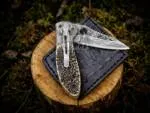
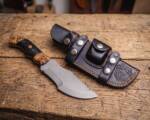
Coyote Ripple pairs two things that usually live in separate catalogs. The blade is forged pattern-welded steel, etched until the layers separate into concentric ripples that spread out from the center of the flat like something dropped in still water. The handle is coyote tan canvas Micarta — cloth and resin, utterly indifferent to weather, the least precious material we stock. One half of this knife belongs in a display case and the other half belongs in a pack, and that combination turns out to suit a lot of hunters better than either extreme.
How the ripples get there
Two steels with different alloy content are stacked, brought to welding heat, and forged into a solid bar. That bar is folded and re-welded until the layer count runs into the hundreds. To get the ripple, the surface is dimpled in a regular grid and then forged flat again, which drives each layer down into a cone and re-exposes it as a ring when the flat is ground. The acid etch does the rest: one alloy darkens, the other stays bright, and the geometry that was hidden inside the bar comes to the surface. Anyone who has wondered what a layer count actually means will find our note on what 352 layers really tells you a good corrective to marketing numbers.
Nine inches of field-dressing knife
The outline is a drop point, and a gut hook is let into the top of the blade close to the point. The hook is the specialist: slide it under the hide, roll the blade over, and pull — the sharpened inner curve opens the abdominal wall while its blunt outer back keeps the point off the viscera. The drop point handles everything after that, from skinning with the belly to caping with the front inch to quartering with the whole edge. The tang runs the full length and full width of the handle, which is what you want the first time you have to lean on a knife to get through a joint. Our guide to full tang versus partial tang construction explains why that matters more on a hunting blade than almost anywhere else.
| Overall Length | 9 inches |
|---|---|
| Blade Length | 4.5 inches |
| Handle Length | 4.5 inches |
| Blade Steel | Hand-forged Damascus, acid etched |
| Blade Finish | Acid etched Damascus with spine jimping |
| Blade Style | Drop point with integral gut hook |
| Handle Material | Coyote tan canvas Micarta |
| Fittings | Brass pins, lanyard hole |
| Tang | Full tang |
| Sheath | Handmade tan leather belt sheath with stud closure (included) |
Model: BMK-1162
Coyote tan Micarta
Micarta is layered cotton canvas saturated with resin and cured under pressure, then ground to shape and hand-sanded. Sanding is what makes it work — it opens the weave slightly and leaves a fine tooth that gets grippier as your hands get wetter, which is the opposite of how polished wood behaves. The tan color reads as a warm desert brown and picks up a lived-in look with handling. These scales are shaped with a long finger groove up front and a slight flare at the butt, so the hand finds its place without a guard. Brass pins secure them to the tang, and a pair of lined holes at the rear take a lanyard or a wrist loop.
Sheath
Tan vegetable-tanned leather, formed damp around the blade so it keeps its shape, then saddle-stitched along the spine edge. A press stud secures the handle strap and the belt loop is cut full height. It arrives pale and will darken to a honey brown over a season of carrying.
Care for a patterned blade
The etched surface is a controlled oxide, and it will keep reacting to moisture if you let it. That is not fragility, it is chemistry. Wash the knife the day you use it, scrub inside the hook where residue collects, and dry it properly rather than leaving it to air off in a truck. Before it goes into storage, run a lightly oiled cloth over both flats. Keep it out of the leather when it is not being carried. If a haze or a rust freckle ever appears, a fine gray abrasive pad with a drop of oil lifts it without harming the pattern — and our page on whether Damascus knives rust goes into what is normal and what is not. Sharpen at the angle it arrived, use a small round ceramic inside the hook, and strop the burr away.
Forged, etched, ground, fitted, and sharpened in Memphis, Tennessee, one at a time.
Carlos Ramirez –
Showed up right on time and looked even better than the photos. Sheath snaps shut securely and doesn’t feel flimsy at all. Black Mamba Knives’ attention to detail is honestly unmatched. Exactly the kind of quality that keeps me coming back.
Christine Anderson –
Solid knife. Glad I ordered it. Still very happy with it and would recommend. Not my first Black Mamba Knives order and it held up to their usual standard.
Brenda Davis –
My skepticism about ordering online disappeared the second this arrived. Came in a nice gift box which made it feel even more special. Weight and balance make it feel like a real working knife not some cheap import. Blade geometry makes it glide through cuts with barely any effort. 10/10 would buy again.
Patrick Diaz –
A bit disappointed with this one honestly. Not sure I’d recommend this one.
Marco Foster –
Set my expectations low going in and this blew right past them. This has quickly replaced my old go to knife for field dressing. Highly recommend this one.
Roger Adams –
Not going to lie. This exceeded my expectations by a lot. Blade geometry makes it glide through cuts with barely any effort. Zero complaints from me on this purchase.
Carol Patel –
Can’t stop showing this off to everyone who comes over. Fit and finish is museum quality. You can tell real craftsmen made this by hand. 10/10 would buy again. Every piece I’ve gotten from Black Mamba Knives has been solid.