

Description
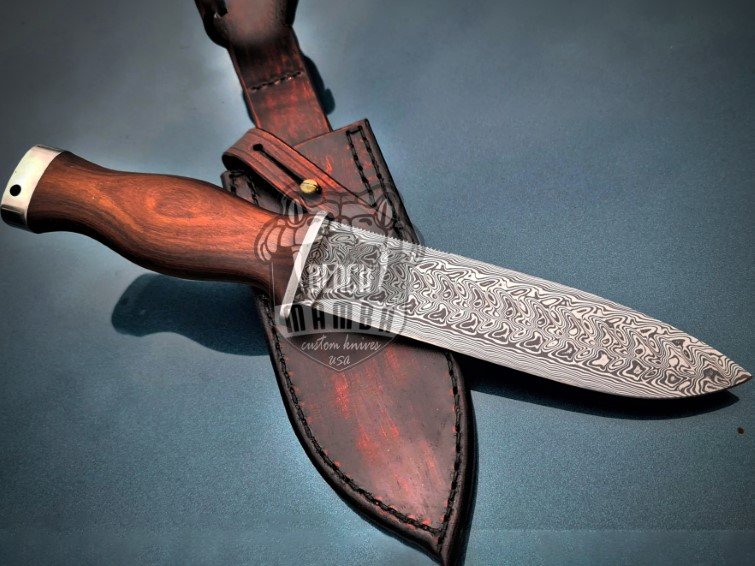
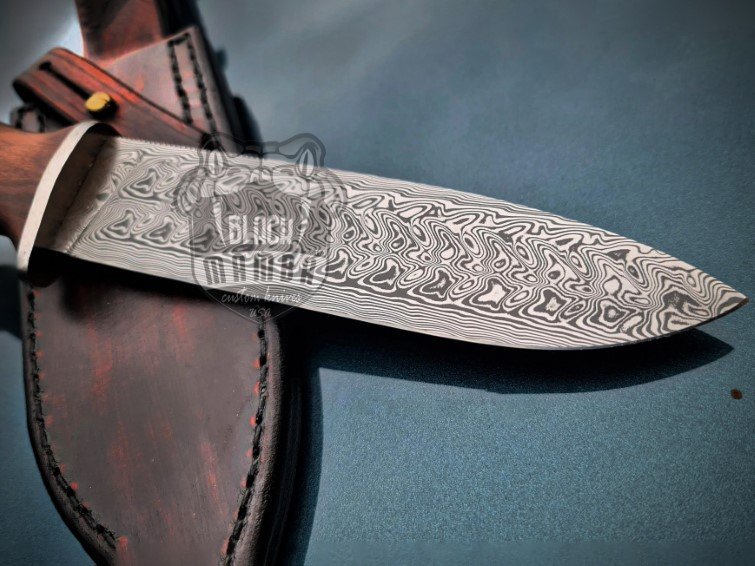
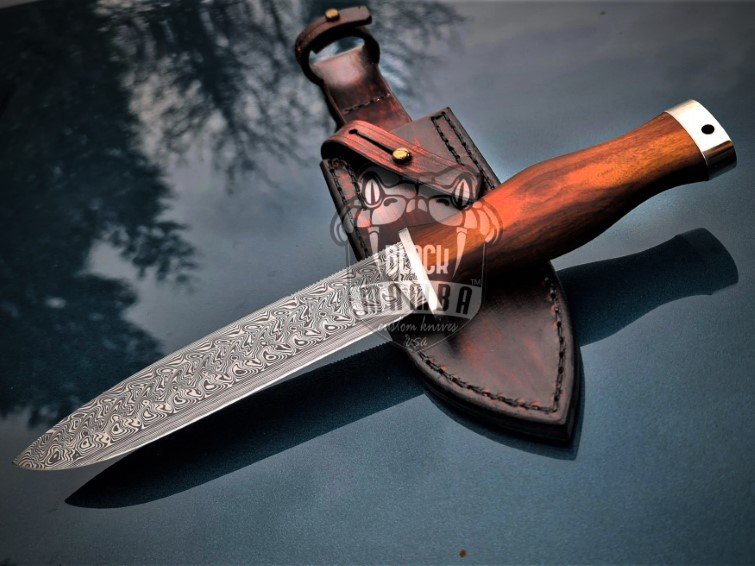
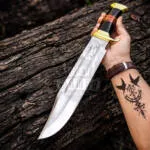
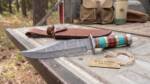
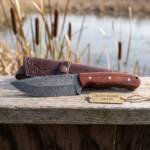
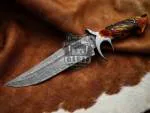
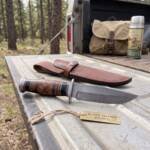
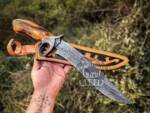
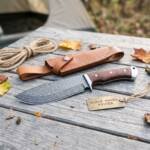
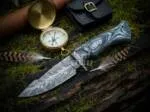
Seven inches of pattern-welded blade on a five inch rosewood handle, with a polished steel bolster between them. The Damascus figure on this one is a tight raindrop, and it runs the full width of the grind.
| Overall length | 12 inches |
| Blade length | 7 inches |
| Handle length | 5 inches |
| Steel | 1095 + 15N20 Damascus |
| Hardness | 58–60 HRC, oil tempered |
| Handle | Rose wood with steel bolster |
| Included | Hand-stitched leather sheath |
Put it to work on: camp cooking, general outdoor cutting, and display. The point is fine and the spine carries a false edge, so it handles like a large dagger rather than a chopper. It is not a splitting tool and the tip will not thank you for prying.
Care: this blade is high-carbon pattern-welded steel, which means it rusts if you let it. The acid etch that makes the pattern visible also leaves a surface that grabs moisture, so dry it properly rather than quickly. Rosewood is naturally oily and needs far less attention than an open-grained wood, but the steel bolster will show fingerprints and dull down over time. A cloth and a trace of oil brings it back. Caring for a Damascus blade is mostly about drying it before you put it away.
Reading the pattern
The layers you can see are alternating bands of two steels forge-welded together and then etched, so one steel darkens and the other stays bright. No two billets fold identically, which is why the figure on your knife will differ from the one photographed. If a pattern looks identical across every knife in a listing, it was printed rather than forged.
Why the point changes what it is for
A narrow symmetrical point penetrates well and gives you real control for detail work close to the tip. It also has less steel supporting it than a drop point does, so lateral force is the enemy. Use it for cutting and it will outlive you. Use it as a lever on a tent stake and you will snap the last half inch off. That is true of every blade in this shape, not a defect in this one.
Twelve inches is a lot of knife
This is a big piece to carry casually. It suits a pack, a truck or a wall far better than a belt worn all day. If you want the same forged steel in something you can actually put in a pocket sheath and forget about, the compact Hornback skinner is a much easier knife to live with.
Practical questions
Is it sharpened on both edges? The spine carries a false edge that is shaped but not brought to a cutting edge. One edge cuts.
Will the pattern wear off? No. It goes through the steel rather than sitting on the surface. Sharpening exposes fresh layers at the edge, which is normal.
Is it legal to carry? Fixed blade carry rules vary widely by state and city. Check where you live before wearing it on a belt in public. Whether a blade counts as a knife or a dagger matters legally in more places than people realize.
Model: BMK-666
Buying for groomsmen? This dagger also comes as a matched set of 6, 15% less than buying six singly, and each one can carry its own engraved name.
Carol Mendoza –
This showed up faster than expected and looked incredible. Every piece of the fit and finish looks hand checked before it shipped. This is going straight into my daily rotation.
Linda Jimenez –
Best knife I’ve ever owned. Hands down. Leather sheath is thick and well stitched. Not the cheap stuff you usually get. Sheath snaps shut securely and doesn’t feel flimsy at all. Love that this comes out of Memphis and still ships worldwide this quickly. Handle feels amazing and the balance is perfect. This is going straight into my daily rotation.
Brenda White –
Solid knife. Glad I ordered it. Been ordering from Black Mamba Knives for a while now and this fits the pattern. Balance is good, just wish the handle had a bit more grip texture. Would order again despite the minor gripes.
Michael Hill –
Good quality knife for the price. Sheath is nice. Wish it had more padding but it does the job. Blade quality is solid. Arrived a bit less sharp than expected but a few passes on a strop fixed it. Solid pickup even with the small issues.
Stephanie Chavez –
Absolutely thoroughly impressed by this knife. Blade geometry makes it glide through cuts with barely any effort. Made in the USA and shipped worldwide with no issues on my end. Shipping was fast and everything arrived well packaged.
Jessica Hill –
Got this for my brother and now I want one for myself too. Blade holds a razor edge right out of the box. This will not be my last order from this shop.
Sandra Jimenez –
Bought this on a whim and it turned out to be one of my favorite purchases in a long time. Came in a nice gift box which made it feel even more special. Took it out camping right away and it handled everything I threw at it. Not my first order from Black Mamba Knives and it won’t be my last. Sheath snaps shut securely and doesn’t feel flimsy at all. Beyond happy with how this turned out.
Jerome West –
Awesome craftsmanship on this one. Pommel and guard are solid, no wobble anywhere on the knife. Already planning my next pickup from this store.
Jacob Green –
Genuinely really impressed with how this turned out. Every piece I’ve gotten from Black Mamba Knives has been solid.
Peter Hunt –
This knife completely won me over the moment I picked it up. Fit and finish is museum quality. You can tell real craftsmen made this by hand. This one’s a keeper for sure.
Hannah Gutierrez –
Ordered late at night on a whim and woke up glad I did. Leather sheath is thick and well stitched. Not the cheap stuff you usually get. So worth it.
Brandon Nguyen –
No regrets on this purchase at all. This seller clearly takes pride in their work.
Shane Ortiz –
Did not expect this level of quality for the price. This has quickly replaced my old go to knife for field dressing. Every piece of the fit and finish looks hand checked before it shipped. Couldn’t be happier with this.