


Description
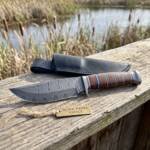
Look at the blade for a moment before anything else. The tight, swirling contours running through Vermillion Coil are not printed, coated or etched onto flat steel — they are the cross-section of a billet that was welded from alternating alloys, drawn out, folded, and forged to shape before being polished and bathed in acid. What the acid leaves behind is a topographic map of everything that happened at the forge, and you can feel the relief with a fingertip.
| Overall Length | 9 inches |
|---|---|
| Blade Length | 4.5 inches |
| Handle Length | 4.5 inches |
| Blade Steel | Hand-forged Damascus, acid etched |
| Blade Finish | Acid etched Damascus |
| Blade Style | Drop point with integral gut hook |
| Handle Material | Rosewood |
| Bolster | Solid brass |
| Fittings | Mosaic pin inlays, brass lanyard tube |
| Tang | Full tang |
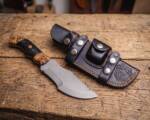
| Sheath | Handmade black leather belt sheath with brass stud (included) |
Rosewood, brass and mosaic
The handle is rosewood: dense, oily, deep reddish brown with dark streaking, and heavy enough to balance the knife back into the palm. It polishes to a glow rather than a gloss and it ages beautifully, darkening a shade or two over the years. A solid brass bolster caps the front and a brass lanyard tube runs through the butt. Set into the scales are mosaic pins — bundles of tiny rods fused together and then sliced into discs, so the figure runs right through the pin rather than sitting on its face. It is a slow way to build a handle and the reason this one looks the way it does.
Still a hunting knife
None of the decoration compromises the job. The blade is a four and a half inch drop point with an integral gut hook, the tang is full width through the handle, and the inside of the hook is opened out and brought to a polish so it parts hide in a single pull. Damascus billets are normalised and forged repeatedly before grinding, which refines the grain, and the finished blade is hardened to carry a real working edge through a field dressing. Whether that is worth the premium is a fair question — we answer it honestly in our piece on the value of Damascus.
Sheath
A black leather belt sheath with a brass stud closure comes with the knife, cut to this blade’s outline, formed damp so it holds the shape, stitched and burnished.
Forged in Memphis, Tennessee
The billet is welded and drawn in our own shop, the blade is forged, hardened and ground here, the rosewood and brass are fitted here, and the sheath is cut and stitched here. Because layer patterns depend on how a particular billet was folded and how the grind cut through it, the figure on your blade will be its own. That is not a caveat; it is the entire appeal of pattern-welded steel.
Looking after pattern-welded steel
Damascus is carbon steel and behaves like carbon steel, which is to say it will rust if you let it. Get it completely dry after any use or handling, and keep a thin film of food-safe oil on it during storage; sweat left overnight can leave a ghost print on the etch. Never store it inside the leather sheath. The pattern is structural and runs all the way through the blade, so sharpening will never remove it — take the main edge to a stone at a steady angle and dress the gut hook with a small round file or tapered rod. Our care and sharpening notes for Damascus go further into the detail. If you prefer olive wood and a stainless bolster, Grove Serpent is the other forged gut hook in this collection.
What you are actually paying for
A forged billet costs hours before a blade even exists: stacking, welding, drawing, folding, cleaning scale off between passes, and losing material at every stage. That labour is the difference between this and a stamped blade with a printed pattern, and it is the reason the price sits where it does. It is also why the finished knife is worth handing down.
Model: BMK-1179

Sarah Rivera –
This knife is phenomenal. No question about it. Fit and finish is museum quality. You can tell real craftsmen made this by hand. Will definitely order again for another one.
Linda Ramos –
Wasn’t expecting to be this impressed but here we are. Proud to support American made goods out of Memphis with this purchase. Blade geometry makes it glide through cuts with barely any effort. Pommel and guard are solid, no wobble anywhere on the knife. This has quickly replaced my old go to knife for field dressing. So worth it.
Logan Richardson –
This blade came razor sharp right out of the box. Fit and finish is museum quality. You can tell real craftsmen made this by hand. Leather sheath is thick and well stitched. Not the cheap stuff you usually get. This one’s a keeper for sure.