


Description
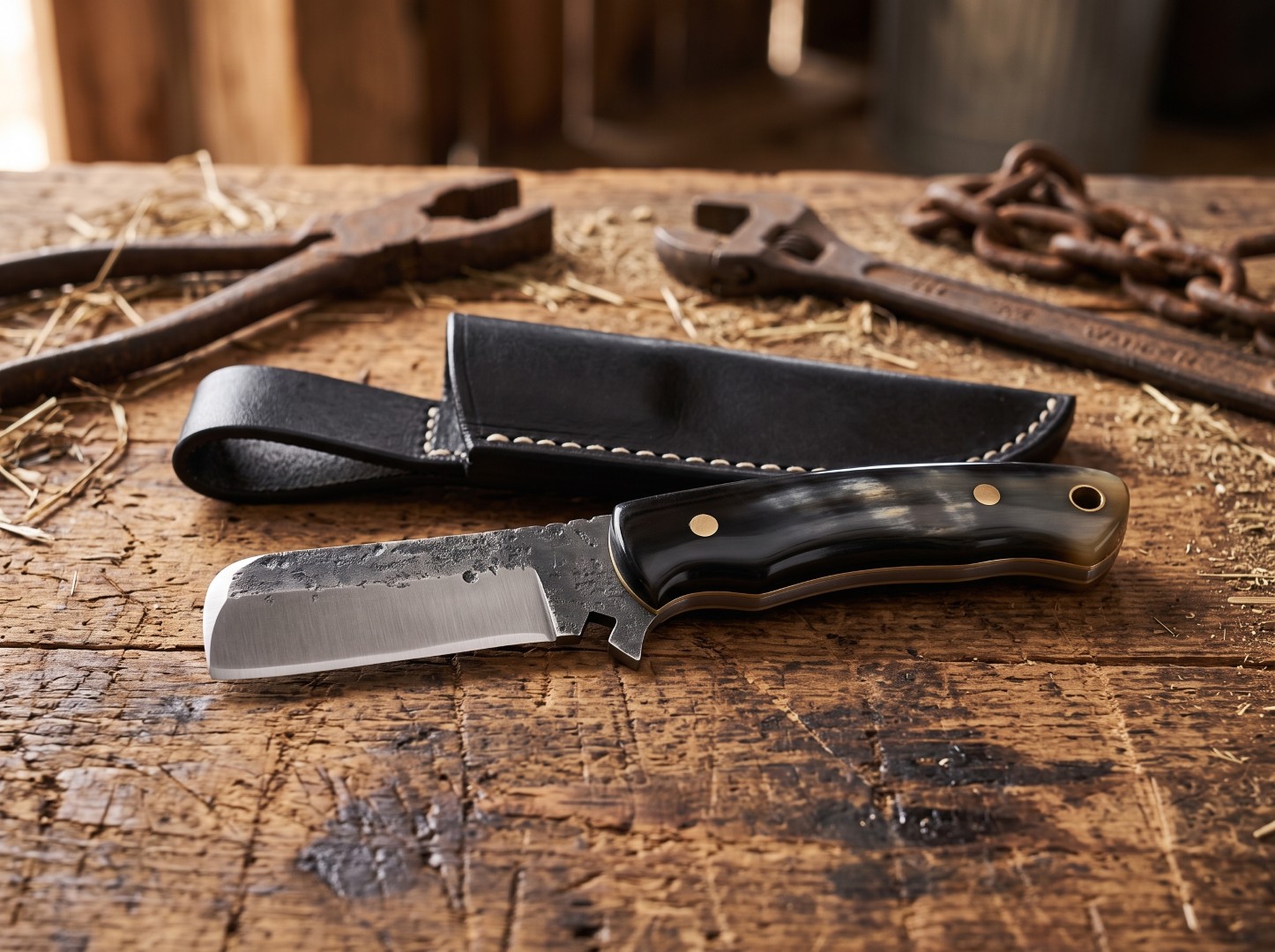
Bull cutters were never meant to be pretty. The pattern came off ranches where a man needed a short, stiff blade with a straight edge and a blunt front that would not puncture anything he did not intend to puncture. The Brass Maverick keeps all of that and adds the one thing the originals rarely had, which is a handle worth looking at.
| Overall Length | 7.5 inches |
|---|---|
| Blade Length | 3.5 inches |
| Handle Length | 4 inches |
| Blade Steel | High carbon spring steel, hand forged |
| Blade Finish | Dark forge texture with polished bevel |
| Blade Style | Sheepsfoot bull cutter with notched choil |
| Handle Material | Buffalo horn |
| Fittings | Brass pins, brass spacer between tang and scales, brass-lined lanyard hole |
| Tang | Full tang |
| Sheath | Handmade black leather belt sheath with contrast stitching (included) |
The blade
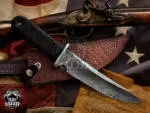
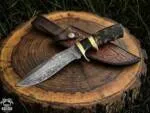
Hand forged from high carbon spring steel, and it looks it. The flat of the blade keeps its dark forge texture, pitted and uneven where the hammer and the scale left their marks, and that texture stops dead at a clean line where the bevel is ground and polished bright. The contrast is the whole point of the finish. A sheepsfoot edge runs dead straight from the choil to a rounded front, which is what makes this shape so good on a cutting board or against a rail: the entire edge lands at once instead of rocking.
The notched choil behind the ricasso is not decoration. Drop your forefinger into it and the knife shortens by an inch, which is what you want for close work when you need the tip under control.
Behind that edge is a flat grind that stays thin all the way to the shoulder, so the blade parts material instead of splitting it apart. Thickness is where most short blades go wrong; make the stock too heavy and a sheepsfoot turns into a chisel that binds in anything soft. We keep it lean and accept that the edge needs a stone more often. If you want to understand how much the grind alone changes the feel of a fixed blade, we broke the common ones down with what each is genuinely good for.
Buffalo horn and brass
The scales are buffalo horn, mostly deep black with cream and honey striations running through where the natural layers show. No two sets are alike and yours will not match the photograph exactly, which is what happens when you use a material that grew rather than one that was moulded. Brass pins hold the scales, a thin brass spacer sits between the tang and the horn as a fine bright line, and the lanyard hole is brass lined so the cord never wears on bare horn.
The tang runs the full length of the handle, which is the construction you want on a knife that gets levered and pried with. If you have never been told why that matters more than the number of pins, our full tang explainer covers it in a couple of minutes.
Sheath and shop
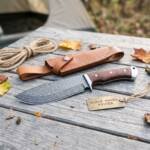
A black leather belt sheath comes with it, hand cut and sewn with cream contrast thread and a wide belt loop that will take a working belt rather than a dress one. Forging, grinding, hardening, fitting and stitching are all done in our Memphis, Tennessee shop.
Care, briefly and honestly
Spring steel rusts. That is the deal you make for the edge it gives you. Get it dry before it goes back in leather, and put something on it if it is going to sit unused: oil, wax, whatever you already have. The forge finish on the flats hides the beginnings of surface rust better than a polished blade would, which is a small mercy but not a licence to ignore it. Horn dislikes heat and dry air, so keep it away from radiators and give the scales an occasional wipe of oil to stop them going chalky. If you would rather have a hammered finish over the whole blade instead of this two-tone treatment, the Anvil Song takes that route.
Model: BMK-1145
Reviews
There are no reviews yet.