
Description
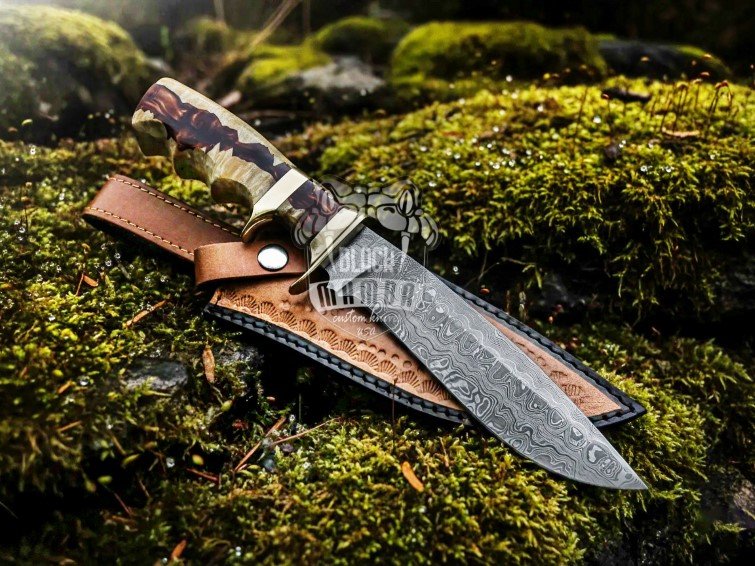
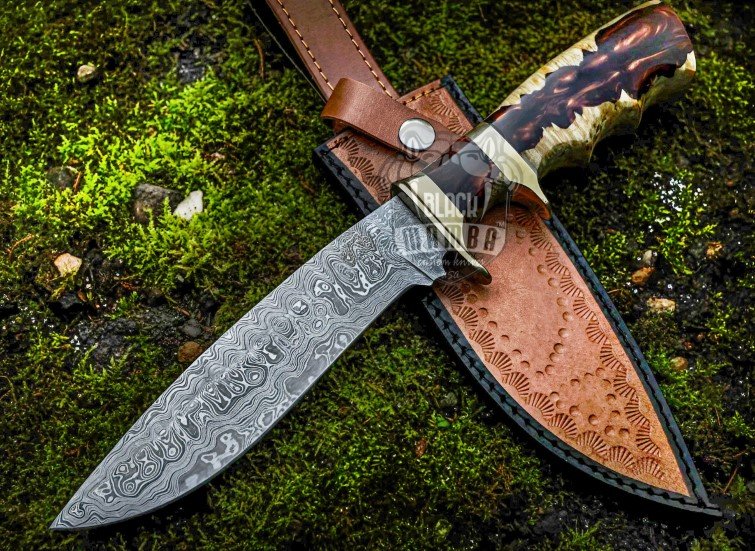
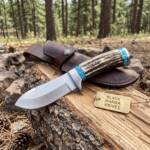
A wide drop point, straight along the spine and long in the belly — the shape you pick when the job is skinning rather than stabbing.
| Overall length | 13 inches |
| Blade length | 8 inches |
| Handle length | 5 inches |
| Handle | Stabilized wood |
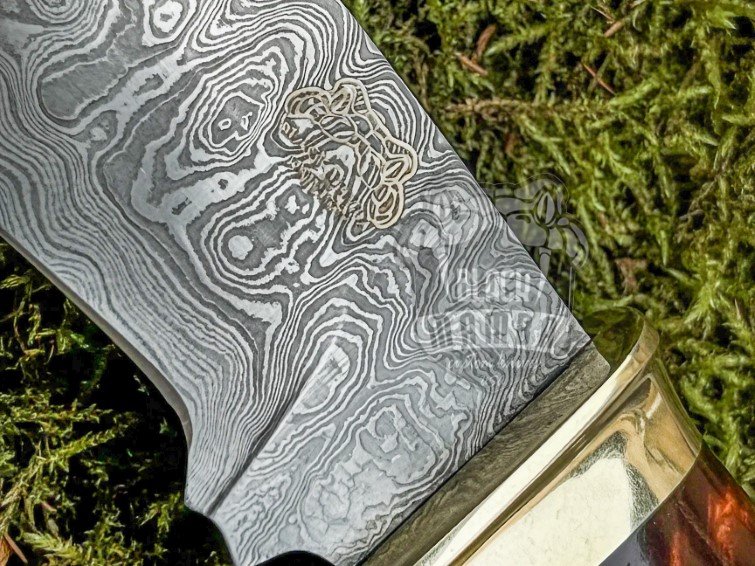
| Steel | 1095 + 15N20 Damascus, 352 layers |
| Hardness | 58–60 HRC, oil tempered |
| Weight | 12 oz |
| Pattern | Damascus Steel |
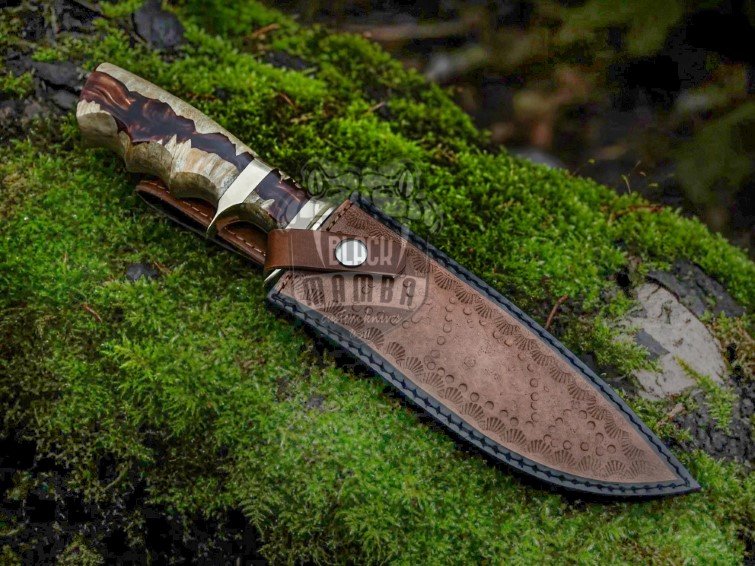
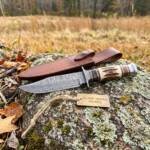
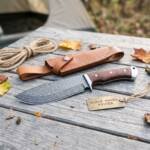
| Included | Hand-stitched leather sheath |
Intended for: the hunter who wants one blade that handles the whole animal. The absence of a clip means the spine stays full thickness right out to the tip, so the point resists the twisting loads that break finer knives when you are working around joints.
Why the spine stays straight
On a clip point, the maker grinds the top of the blade away to bring the tip lower and thinner. That helps penetration and costs strength. Here the spine runs unbroken almost to the end, which does three things: the tip survives levering, the blade keeps mass along its length so it cuts heavy material without deflecting, and your thumb can sit flat on the spine for control. What you lose is a deep, clean puncture. Our skinning knife guide explains where each shape stops working.
Twelve ounces, and the finger grooves
Twelve ounces on an eight inch blade is a lot of steel, and this handle is scalloped into finger grooves to manage it. Grooves divide opinion: when your hand matches them they lock you into a secure grip, and when it does not they force your fingers where they did not want to go. If your hands are large, take that seriously before buying. When they fit, a bloody hand stays put without gripping hard, which is why a heavy knife stays safe for hours.
The handle material
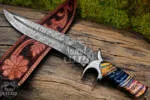
The scales are a cast composite in cream and deep burgundy, cut so the swirl runs continuously around the profile. Poured material is completely closed — nothing soaks in, nothing swells, and blood or salt water wipes off rather than staining. That beats a natural handle for wet work, at the cost of the warmth wood gives in the cold. Every block is poured separately, so the pattern on yours will not repeat what you see here.
Care for this blade
Damascus is a construction, not a stainless alloy, so the rules are those for any high carbon knife. Rinse and dry as soon as the work is done, getting into the junction between blade and guard, which stays wet longest. A wiped-on film of mineral oil protects it between hunts. Leave it out of the sheath in the off season. Sharpening, follow the belly through its curve — lift the handle slightly as you reach the tip so the whole edge meets the stone evenly, or the sweep gradually flattens and the knife loses what makes it good. For the clip point version at the same dimensions, see the Copperhead Snake bowie.
Questions buyers ask
Is it too heavy for caping? Yes, honestly. Twelve ounces is for the big work — carry a small blade for the head and the fine cuts. Our blade shapes guide covers the sizes worth pairing.
Does the brass guard get in the way? It stops you choking fully onto the ricasso, which is the trade for a hand stop you can trust when wet.
Is the sheath included? Yes, stitched leather with a retaining strap.
Model: BMK-651

Mary Myers –
This is the kind of knife you show off without even meaning to. Sheath snaps shut securely and doesn’t feel flimsy at all. Leather sheath is thick and well stitched. Not the cheap stuff you usually get. Handle has a great grip even with wet or gloved hands. Happy customer here, through and through.
Antonio Hernandez –
Not quite what I was hoping for. Leather sheath was thinner than shown in the pictures. Not sure I’d recommend this one.
DeShawn Jefferson –
Feels way more premium than the price suggests. Pommel and guard are solid, no wobble anywhere on the knife. Handle has a great grip even with wet or gloved hands. Blade geometry makes it glide through cuts with barely any effort. Zero complaints from me on this purchase.
Hunter Ward –
This is the kind of knife you show off without even meaning to.
Thomas Alexander –
This knife is fairly solid. Just a couple small things kept it from 5 stars. Solid pickup even with the small issues.