


Description
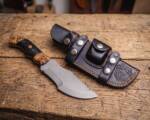
Fernline was not drawn for a display cabinet. It was drawn for the hunter who goes out in weather nobody would choose, comes back muddy to the elbow, and wants a tool that can be rinsed off and put away without ceremony. Olive green canvas Micarta, brass hardware, a bright satin D2 blade with a hook cut into the spine — there is nothing on this knife that resents rain, blood or a week living in the bottom of a pack.
What the steel is doing for you
D2 began life as an industrial die steel, and that history explains most of its behaviour. A punch die has to hold its exact profile through thousands of strikes, and the dense chromium carbides that make that possible are the same carbides that keep a hunting edge biting long after a soft stainless blade has gone slick. Hardened into the high fifties, this blade will see a whole deer through from first cut to last without a stop at the strop. The tradeoff is honest: D2 sits just under the chromium threshold for true stainless, so it is rust resistant rather than rust proof. If you want the alloys laid out beside one another before you commit, our side-by-side look at the common knife steels is worth ten minutes.
| Overall Length | 9 inches |
|---|---|
| Blade Length | 4.5 inches |
| Handle Length | 4.5 inches |
| Blade Steel | D2 tool steel |
| Blade Finish | Polished satin |
| Blade Style | Drop point with integral gut hook |
| Handle Material | Olive green canvas Micarta |
| Fittings | Brass pins, lanyard hole |
| Tang | Full tang |
| Sheath | Handmade dark brown leather belt sheath (included) |
Micarta, and why it belongs on a wet-weather knife
The handle is olive green canvas Micarta, which is woven cotton duck saturated with phenolic resin and cured under pressure until it behaves more like a dense hardwood than a plastic. Sanded to a low sheen, the weave leaves a faint tooth in the surface that actually improves its bite once your hands are slick. It will not swell, split, sour or harbour anything, and it takes a scrubbing with dish soap without complaint. The scales are bedded on brass hardware with a lanyard opening at the butt, and the whole handle is contoured so the web of your thumb falls into the same place every time you draw it.
The hook and the edge
A gut hook is only as good as the inside of its curve, so that curve is opened up, filed and polished by hand rather than left as it came off the grinder. Pushed under the hide, it parts skin in one continuous pull and keeps your point clear of the paunch — the one cut in field dressing that ruins meat when it goes wrong. Ahead of the hook the drop point is flat ground and finished at a working bevel, ready to skin, cape and quarter. There is jimping filed into the spine at the ricasso for thumb purchase on detail cuts.
Cut and stitched in Memphis
Every part of this knife is made in our Memphis, Tennessee shop. The blank is profiled, heat treated, ground and hand finished under one roof, and the dark brown belt sheath is cut, wetted, formed around this exact blade and saddle stitched before it ships with the knife. Two people can build the same pattern and you will still see their hands in the result, which is the point of buying handmade. Prefer a matte blade for the same job? The stonewashed Sagebrush is the low-glare version of this idea.
Keeping it right
Dry the blade properly when you are done, and pay special attention to the inside of the hook, where hair and blood love to sit. A thin film of any food-safe oil before a long rest in the safe is plenty. The Micarta asks for nothing more than soap and warm water. Leather holds moisture, so store the knife out of its sheath rather than in it, and keep both away from radiators and dishwashers. For the hook, skip the bench stone — a tapered ceramic rod or a small round file worked from the inside outward is the tool that fits. Read our explanation of what a gut hook actually does if this is your first one.
Model: BMK-1166

Douglas Ramirez –
This knife is a genuine work of art. Even the small details in the damascus pattern are crisp and clean. This is the kind of purchase that makes online shopping worth it.
Marco Martinez –
Set my expectations low going in and this blew right past them. Edge retention has been great even after regular use in the field. Steel has a gorgeous pattern that looks different in every light. Sheath snaps shut securely and doesn’t feel flimsy at all. Beyond happy with how this turned out.
Alexander West –
This is one of those purchases that just makes you smile. Fit and finish is museum quality. You can tell real craftsmen made this by hand. This maker clearly takes pride in their work.
Rafael Bailey –
The moment I saw this in person I knew it was a keeper. Leather sheath is thick and well stitched. Not the cheap stuff you usually get. This will not be my last order from this seller. Good to know real Memphis craftsmen are behind this, and shipping was quick too.
Alejandro Perez –
Bought this on a whim and it turned out to be one of my favorite purchases recently. Weight and balance make it feel like a real working knife not some cheap import. Pommel and guard are solid, no wobble anywhere on the knife. Blade geometry makes it glide through cuts with barely any effort. If you’re on the fence just get it. You won’t regret it.
Carlos Torres –
This knife looks even better in person than in the listing photos. Fit and finish is museum quality. You can tell real craftsmen made this by hand. Sheath snaps shut securely and doesn’t feel flimsy at all. Shipping was fast and everything arrived well packaged.