


Description
The screws are the first thing worth mentioning. Moss Creek is built with black hardware rather than peened pins, which means that at the end of a season you can take the scales off, clean the tang properly, dry everything, and put it back together. Nobody ever does that with a pinned knife, because nobody can. It is a small design decision that says most of what you need to know about who this knife was drawn for.
Finish and colour
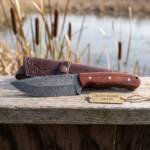
The D2 blade is stonewashed to a matte grey — tumbled with abrasive media after grinding so the surface takes a fine random texture instead of a mirror. It does not flash in low sun, it hides working scratches, and the slight roughness helps a film of oil cling to the steel. The scales are olive green canvas Micarta, contoured with a palm swell, so the whole knife sits somewhere between deep green and gunmetal and looks like it belongs in wet timber.
| Overall Length | 9 inches |
|---|---|
| Blade Length | 4.5 inches |
| Handle Length | 4.5 inches |
| Blade Steel | D2 tool steel |
| Blade Finish | Stonewashed matte gray with spine jimping |
| Blade Style | Drop point with integral gut hook |
| Handle Material | Olive green canvas Micarta, contoured |
| Fittings | Black screw hardware, lanyard hole |
| Tang | Full tang |
| Sheath | Handmade black leather belt sheath with stud closure (included) |
Micarta, properly explained
Canvas Micarta is cotton duck cloth stacked in phenolic resin and cured under heat and pressure. The result is inert: it does not absorb water or blood, it will not swell in humidity or shrink in a dry winter, and it is unbothered by solvents and cleaning products. Sanded, the exposed weave leaves a fine texture that grips better wet than dry — the opposite of polished wood, and precisely what you want on a knife used for field dressing.
The hook and the spine
A gut hook is let into the spine and hand dressed along the inside of its curve so it opens hide in one controlled draw with the blunt back riding against the skin. Behind it, jimping filed into the spine gives your thumb a positive place to sit. Forward of that, the drop point carries plenty of belly for skinning and a tip fine enough for caping work. D2 supplies the edge retention that lets you finish the job without stopping — plenty of carbon, a heavy chromium load, hardness up in the high fifties, and semi-stainless rather than fully stainless. Our steel comparison puts it beside the alternatives.
Sheath and workshop
Black leather belt sheath included: cut to this blade, formed damp, stitched, edge burnished, snap strap over the handle. Everything is made in Memphis, Tennessee — profiling, heat treatment, grinding, assembly, hand finishing and leatherwork — by a small crew who see the same knife through from bar stock to box.
Realistic care
Dry the blade after use and clear the inside of the hook, which traps hair and moisture. Once a season, back out the screws, clean underneath, and reassemble with a drop of thread locker. A thin protective oil before long storage covers the rest. Wash the Micarta with soap and warm water. Do not keep the knife inside the leather between trips — our storage guide explains what trapped damp does to steel — and keep it out of the dishwasher entirely. For the blacked-out version of the same working knife, look at Nightfall.
What it is for
Deer, hog and elk camp work above all: opening an animal, skinning, quartering, and everything that follows around a fire afterwards. The matte finish and green scales suit anyone who spends time in wet timber, and the four and a half inch blade is long enough for real work while staying legal to carry in most of the country. It is a knife bought to be used hard rather than admired.
Balance sits just behind the ricasso, so the point stays easy to steer through close work. The full tang gives you something solid to lean on when a joint refuses to open, and the contoured scales spread that pressure across the palm instead of concentrating it under the fingers.
Model: BMK-1178
Laura Ruiz –
This showed up faster than expected and looked incredible. This is exactly why I keep coming back to this seller.
Derek Sanders –
My brother was speechless when I showed them this knife. Blade holds a razor edge right out of the box. This has quickly replaced my old go to knife for field dressing. This will not be my last order from this store.
Douglas Nguyen –
Ended up ordering a second one after how happy I was with the first. This is exactly why I keep coming back to this seller.