


Description
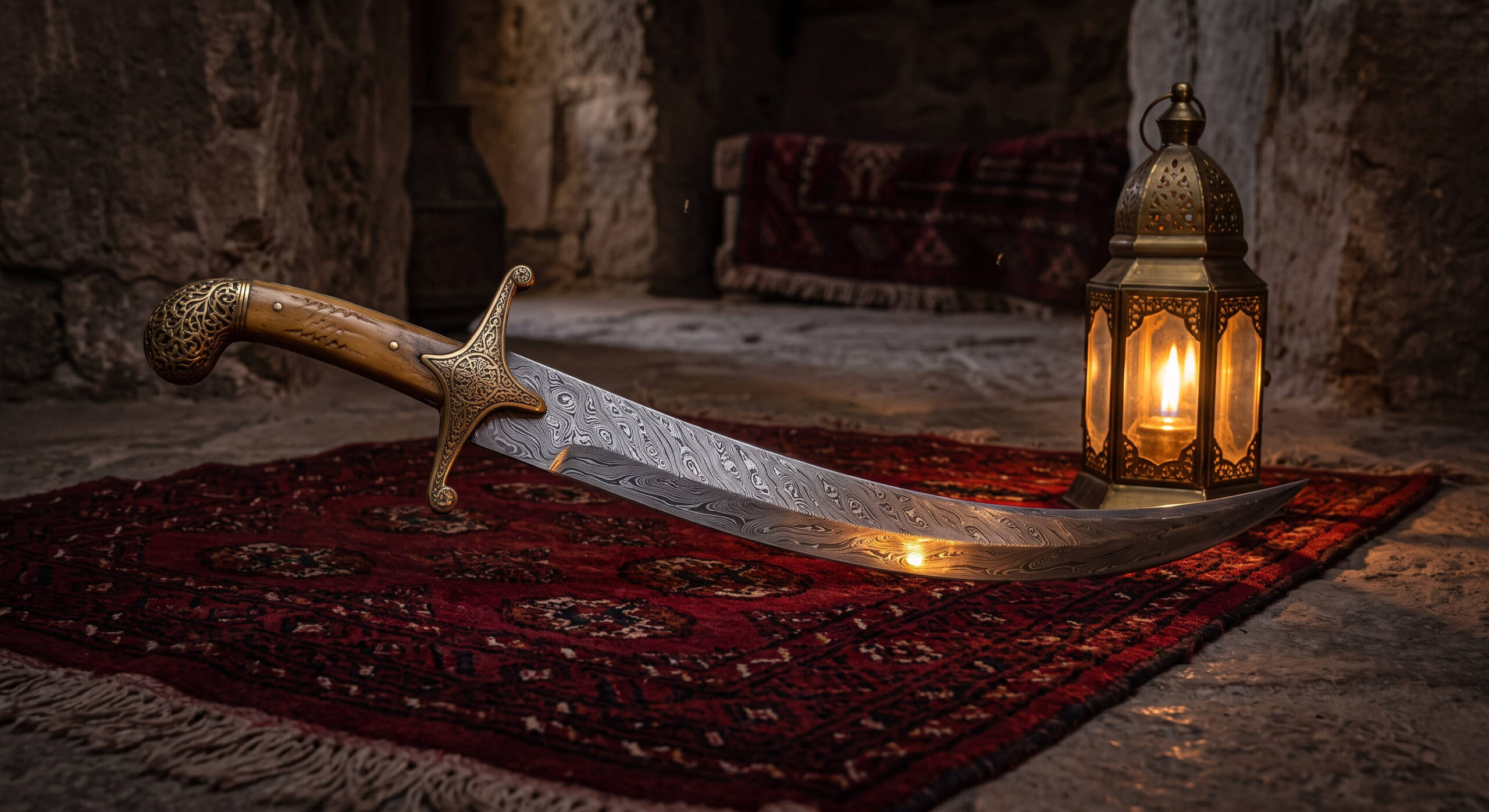
Desert Sultan is an Arabian scimitar, and the thing to look at first is the curve. It runs continuously from guard to point with no straight section anywhere along the thirty inches — no yelman, no clip, no change of mind. One long arc, single edged, the whole length.
The steel is hand-forged Damascus in a raindrop pattern, high polished. The handle is camel bone with brass pins, pale against the dark figure of the blade. The crossguard is hand engraved brass with downturned quillons, and the pommel is a curved engraved brass cap that hooks back over the heel of the hand.
| Overall length | 30 inches |
| Blade | Deep continuous curve, single edged scimitar |
| Steel | Hand-forged Damascus, raindrop pattern |
| Finish | High polish |
| Handle | Camel bone with brass pins |
| Crossguard | Hand engraved brass, downturned quillons |
| Pommel | Curved brass, hand engraved |
| Presentation box | Optional — walnut with green velvet lining |
Made for: display, and for someone who wants a sword that reads as an object rather than a weapon. Pale bone against etched Damascus and warm brass is a deliberate palette. This is a presentation piece — the optional walnut box with green velvet lining says so as plainly as anything in the specification.
Why a continuous curve cuts differently
A curved edge does not meet its target square. It arrives at an angle and keeps sliding as the sword travels, so the cut lengthens as it deepens — a drawing cut rather than a chop. That is why the shape belongs to cavalry: a rider is already moving, and a curve turns forward motion into a longer cut without needing a heavy blade or a strong arm.
Camel bone, and what it is like
Bone is traditional across the region this shape comes from. It takes a smooth polish, stays cool to the touch, and is never uniform — density varies through the piece, so color and fine grain differ from handle to handle. It is also a natural material with a natural material’s habits: more brittle than wood, and unhappy near radiators, dashboards and direct sun.
Raindrop, and how it is made
Raindrop comes from drilling or pressing dimples into the billet and then grinding the surface flat again. That cuts down through the fold stack and exposes the layers as concentric rings, so every ring you see is a cross-section through the folds rather than a mark applied to the surface. It is the pattern most people picture when they hear the word Damascus.
Routine care: under that pattern the blade is high carbon steel, so it rusts like high carbon steel — yes, Damascus rusts, and the fix is simple. Wipe it after handling, keep a thin film of oil on the polish, never put it away damp. Brass will patina; polish restores it, but keep abrasives off the engraving. Wipe the bone with a dry cloth only.
FAQs
Is the camel bone dyed? No. The color is the natural material, which is why it varies between pieces.
Does the walnut box come with it? Only if you add it at checkout.
Is this a functional sword? It is built and finished as a collector’s display piece. Do not cut or spar with it.
Is the pattern worth the money? That is a fair question, and are Damascus knives worth it answers it without the sales pitch.
How does it differ from your kilij? The Emerald Crescent Turkish kilij is the same length but flares into a yelman, which this one deliberately does not.
Make it a gift: add laser engraving at checkout, and consider the walnut box. Every order ships from Memphis, TN with a lifetime warranty — backed by 2,000+ verified customer reviews.
Model: BMK-1134
Reviews
There are no reviews yet.