

Description
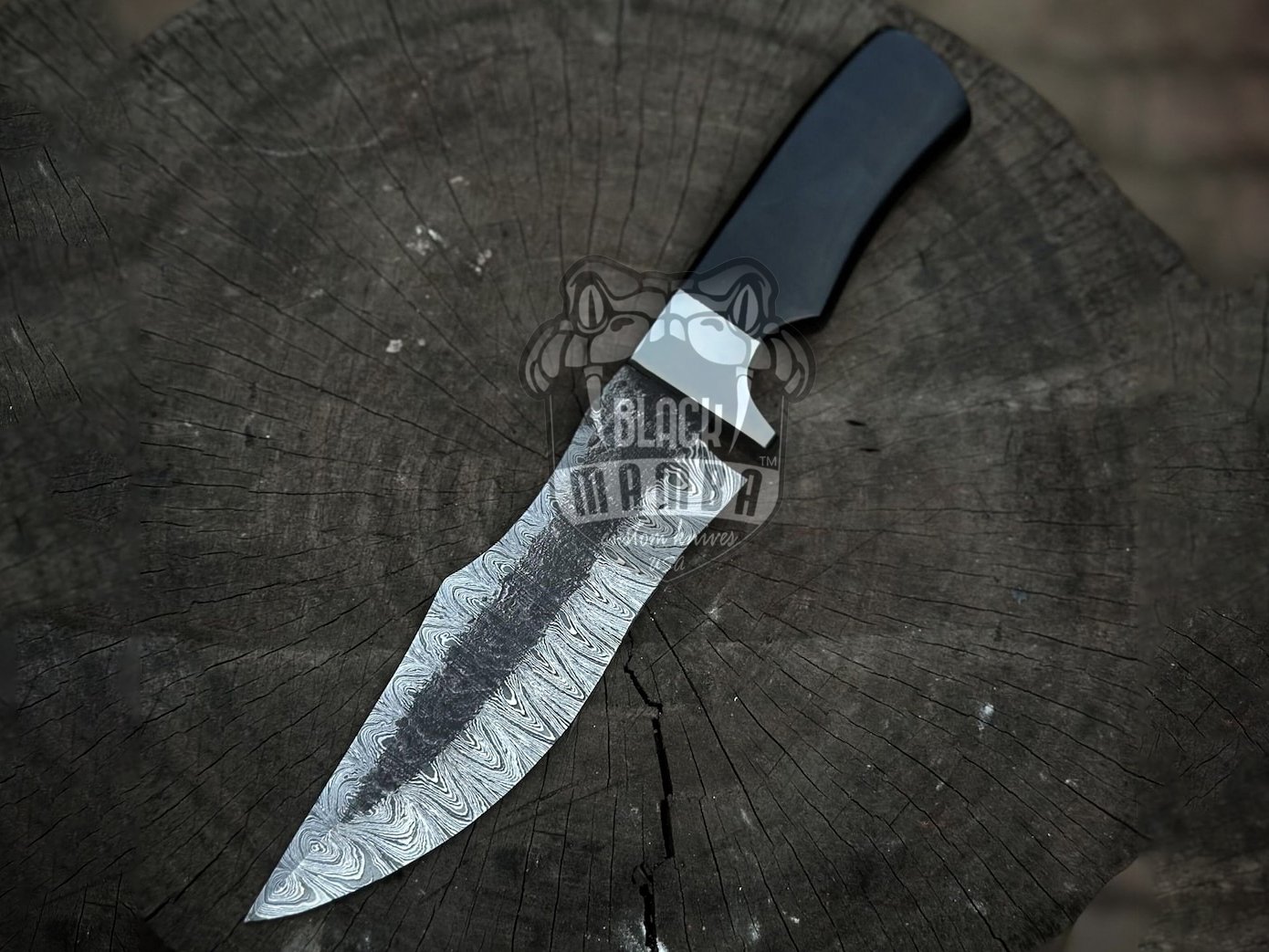
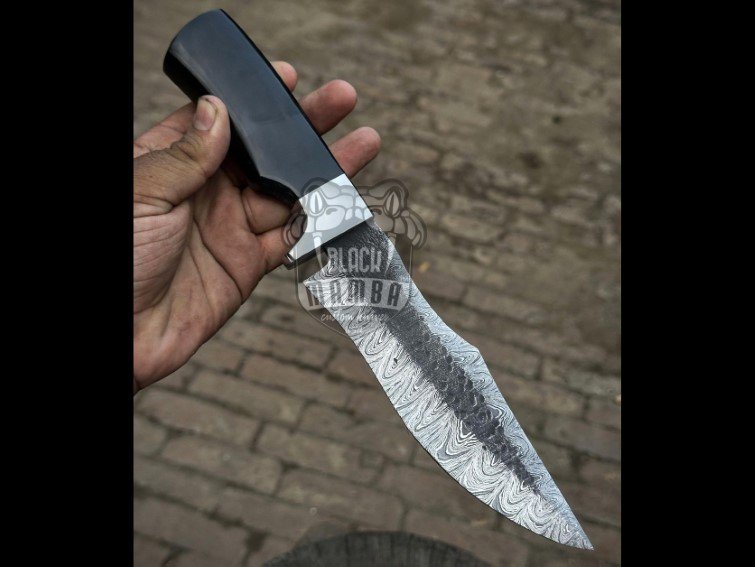
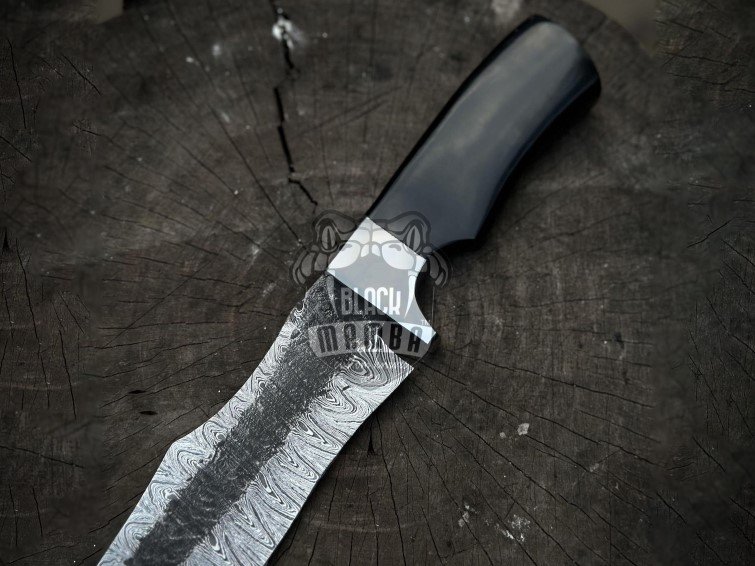
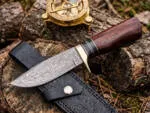
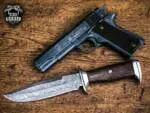
A dark stripe runs down the center of this blade where the pattern compresses, which is what the forging does when the billet is drawn out under the hammer rather than pressed flat.
| Overall length | 12 inches |
| Blade length | 7 inches |
| Handle length | 5 inches |
| Steel | 1095 + 15N20 Damascus |
| Hardness | 58–60 HRC, oil tempered |
| Handle | Black Resin |
| Included | Hand-stitched leather sheath |
Well matched to: a first serious Damascus purchase. It is a straightforward hunting bowie with no exotic materials to look after, priced where a working knife should be, and the pattern on it is emphatic enough to see across a room.
Reading this pattern
The figure runs in long parallel waves along the blade, tightening into that darker band through the middle. The center of a billet sees less deformation than the edges when it is drawn out, so the layers there stay compressed and the etch reads darker. It is a forging artifact, not a surface treatment. To confirm any Damascus, look at the edge bevel: the pattern should carry across it and change scale, because you are seeing the layers in cross-section. A printed fake stops dead at the bevel. Our guide to spotting fake Damascus covers the other tells.
The upswept clip point
Seven inches of blade with a rising tip and a full belly, which puts the point above your knuckles in a normal grip. That favors skinning strokes: you drag the belly and the tip stays clear of the meat instead of nicking it. It also rules out detailed carving, because the useful edge is all curve. Push cuts happen back near the ricasso.
Black resin, and why it is here
The handle is solid black resin polished to a gloss, with a steel bolster at the front. That is a deliberately plain choice on a knife with a busy blade — figured scales would fight the pattern for attention, and black ones let the steel talk. Practically, resin is the most maintenance-free handle material there is: it absorbs neither blood nor water, never needs oiling, will not crack in a dry house, and cleans with dish soap. What it does show is scratching, and on gloss black that is visible under direct light. A plastic polish takes them out.
What this blade needs from you
Very little, provided you are consistent. The resin needs nothing. The steel wants drying after use, a thin coat of oil before it is put away, and storage outside the sheath. Watch the joint where the blade meets the bolster, since that seam holds water after a rinse and is where spotting starts; a nylon pad and oil lift a spot before it becomes a pit. Sharpen with a rocking motion that follows the upswept curve, and finish on a strop or a smooth steel rather than a coarse rod — our honing versus sharpening explainer covers what each actually does.
Questions buyers ask
Will the black handle fade? No. The color is through the resin, not on it.
How does it compare to a wood-handled version? Resin is tougher and warmer to look after; wood is warmer to hold. The Wildwood Warden in rose wood is the direct comparison.
Is the edge ready to use? Yes, it ships sharp and needs only stropping for the first few months.
Model: BMK-671

Rafael King –
Honestly one of my better purchases in a while. Fit and finish is museum quality. You can tell real craftsmen made this by hand. Black Mamba Knives has earned a repeat customer with this one. Love it.
Stephen West –
Feels way more premium than the price suggests. Already thinking about what to order next from this store.
Kenneth Fox –
No regrets on this purchase at all. Steel has a gorgeous pattern that looks different in every light. This one’s a keeper for sure.
Hannah Sanders –
Was nervous ordering something like this online but so glad I did. Every piece of the fit and finish looks hand checked before it shipped. Couldn’t be happier with this.
Kimberly Perez –
This thing is a beast in the best way. Weight and balance make it feel like a real working knife not some cheap import. Telling everyone I know to check this seller out.
Shane Jimenez –
This knife is solid but not quite perfect. Not my first Black Mamba Knives order and it held up to their usual standard.
Walter Ross –
Everyone who’s seen this knife has asked where I got it. Blade geometry makes it glide through cuts with barely any effort. Will definitely order again for another one. Love that this comes out of Memphis and still ships worldwide this quickly.
Michael Martin –
Genuinely extremely happy with how this turned out.
Joseph Rogers –
Honestly one of my better purchases in a while. Good to know real Memphis craftsmen are behind this, and shipping was quick too. Every piece of the fit and finish looks hand checked before it shipped. 10/10 would buy again.
Douglas Brown –
Best knife I’ve ever owned. Hands down. Edge retention has been great even after regular use in the field. Can’t recommend this enough.
Henry Smith –
This knife is good but not quite perfect. Blade holds up well, edge retention could be slightly better. Blade quality is solid. Arrived a bit less sharp than expected but a few passes on a strop fixed it. Glad I made this purchase.
Adam Wilson –
The moment I saw this in person I knew it was a keeper. So worth it.
Alan Collins –
This blade came razor sharp right out of the box. Pommel and guard are solid, no wobble anywhere on the knife. Blade holds a razor edge right out of the box. Leather sheath is thick and well stitched. Not the cheap stuff you usually get. This is exactly why I keep coming back to this seller.
Ronald Hunt –
This knife has already earned a permanent spot in my collection. Even the small details in the damascus pattern are crisp and clean. Telling everyone I know to check this company out.
Michelle Mitchell –
This knife completely won me over the moment I picked it up. This has quickly replaced my old go to knife for field dressing. Love it.
Blake Ward –
Wasn’t sure what to expect but this knife nailed it. Ordered from Black Mamba Knives before and the quality stays consistent every time.
Ashley Peterson –
This knife is a genuine work of art. Handle feels amazing and the balance is perfect. Every piece of the fit and finish looks hand checked before it shipped. Leather sheath is thick and well stitched. Not the cheap stuff you usually get. Can’t say enough good things about this purchase.
Melissa Mendoza –
Nice piece for the price. Would order again despite the minor gripes.
Jonathan Wells –
Everyone who’s seen this knife has asked where I got it. This is my new favorite in the collection.
Wyatt Reed –
No regrets on this purchase at all. Ordered from Black Mamba Knives before and the quality stays consistent every time.
Deborah Parker –
Been eyeing this knife for a long time and it did not disappoint. Handle feels amazing and the balance is perfect. Can’t wait to see what else this maker has to offer.
Grace Cruz –
Wasn’t sure what to expect but this knife nailed it. Ordered from Black Mamba Knives before and the quality stays consistent every time. This has quickly replaced my old go to knife for field dressing. This one’s a keeper for sure.
Donald Reyes –
Been eyeing this knife for a while and it did not disappoint. Made in the USA and shipped worldwide with no issues on my end. Even the small details in the damascus pattern are crisp and clean. Definitely bookmarking this store for future orders.
Jeffrey Davis –
First rate quality for the price point. Handle feels amazing and the balance is perfect. Already telling my friends to check this out.
Pamela Sullivan –
Can’t stop showing this off to everyone who comes over. Would send this as a gift again in a heartbeat.
Barbara Reyes –
This turned out to be way better than I thought it would be. Fit and finish is museum quality. You can tell real craftsmen made this by hand. Good to know real Memphis craftsmen are behind this, and shipping was quick too. Handle has a great grip even with wet or gloved hands. Love it.
Kimberly Harris –
Ordered late at night on a whim and woke up glad I did. Leather sheath is thick and well stitched. Not the cheap stuff you usually get. Steel has a gorgeous pattern that looks different in every light. Sheath snaps shut securely and doesn’t feel flimsy at all. This store clearly takes pride in their work.
Mark Ward –
Was nervous ordering something like this online but so glad I did. Handle has a great grip even with wet or gloved hands. Already telling my friends to check this out.