
Description
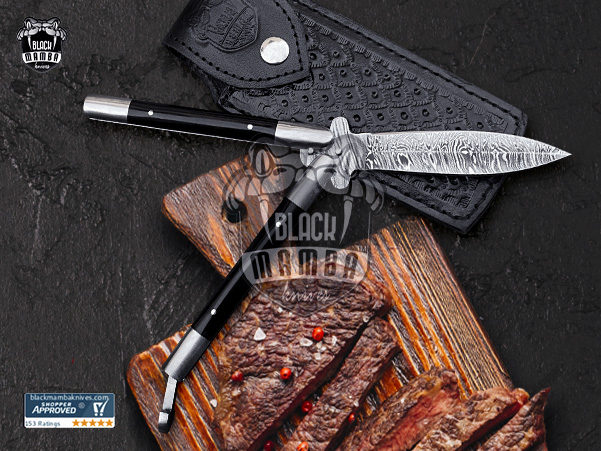
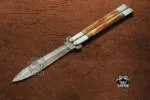
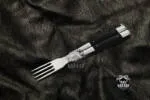
Damascus in a stainless frame, with kamagong inserts that go almost black against the bright steel.
| Overall length | 9.1 inches |
| Blade length | 4.4 inches |
| Handle length | 4.7 inches |
| Steel | 1095 + 15N20 Damascus, 352 layers |
| Hardness | 58–60 HRC, oil tempered |
| Handle | – Stainless Steel with Kamagong Wood Inserts |
Made for: the collector who wants the pattern to be the loudest thing on the knife. A stainless frame is a cool, neutral surround, and against it both the 352-layer billet and the near-black wood read harder than they would inside brass.
Reading 352 layers on a short blade
Layer count is a record of folding, not a quality score. The starting stock is welded, drawn, cut and re-welded until 1095 and 15N20 are stacked 352 deep, then the surface is etched so the two alloys separate into light and dark. On 4.4 inches of blade those bands sit close together, so the figure reads as fine texture rather than as broad sweeping waves. The arithmetic is set out in what 352 layers actually means.
Stainless around wood
A metal frame and a natural insert expand at different rates, and stainless moves more with temperature than kamagong does. In practice that shows up as a hairline you can catch with a fingernail on a cold morning and cannot find in July. It is not a fault and nothing works loose because of it, since the wood is pinned rather than glued in place.
What 58 to 60 HRC buys you
The sheet gives 58 to 60 HRC, oil tempered. That band is the compromise most makers land on for a folding knife: hard enough that the edge does not roll when the blade taps a handle on a bad catch, soft enough that a corner chips rather than the whole tip letting go. It also means an ordinary medium stone will raise a burr without an argument.
Care: the frame is stainless but the blade is not, and 1095 will spot if left wet. Wipe it down, oil the flats occasionally, and keep the etched face away from anything acidic. Citrus and tomato will bleach the contrast out of a Damascus pattern faster than water will rust it. The kamagong is dense enough to ignore, and a dry cloth is all it ever needs.
FAQs
Will the pattern wear off? No. The contrast comes from two different steels inside the bar rather than from a coating, so sharpening exposes fresh pattern instead of removing it. Heavy polishing can flatten the etch, and a re-etch brings it back.
How does this compare with the D2 version? Different arguments entirely. The D2 kamagong balisong holds an edge longer and costs less. This one is bought for the blade figure.
Is there anything at the opposite end of the shelf? The blue resin tanto balisong goes the other way completely: synthetic handle, hard chisel point, no natural material anywhere on it.
Model: BMK-416
Not sure this is the one? See every balisong knife we make in one place.
Daniel H. (verified owner) –
I recently added a steel butterfly knife from this shop to my collection, and it has quickly become one of my most cherished pieces. The design and quality are exceptional.
Mia L. (verified owner) –
The steel butterfly knife I received from this store is visually captivating and incredibly functional. It’s now my go-to tool for various tasks. Highly recommended!
Liam R. (verified owner) –
I’ve been collecting knives for years, and this store ranks among my favorites. The steel butterfly knife I purchased here is a shining example of craftsmanship and excellence.
Carlos Kim –
Bought this on a whim and it turned out to be one of my favorite purchases this year. Latch snaps shut clean every time. Shipping was fast and everything arrived well packaged.
Andre Flores –
Set my expectations low going in and this blew right past them. This flips cleaner than knives twice the price. Weight is perfectly balanced for flipping. Highly recommend this one.
Jason Wilson –
This balisong has quickly become my favorite piece in the collection. Bushings feel buttery smooth after just a bit of use. This maker nailed it with this one.