
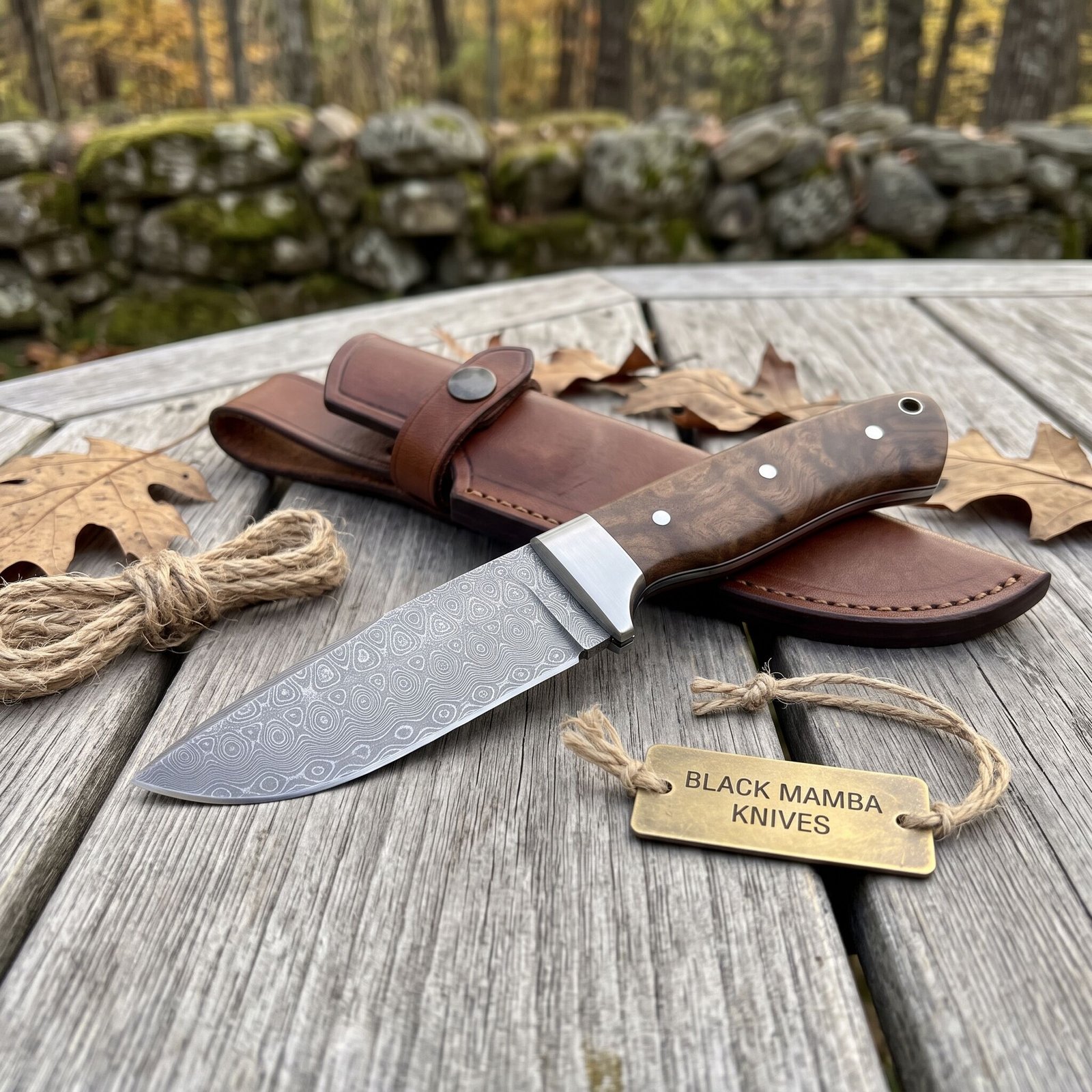
Description
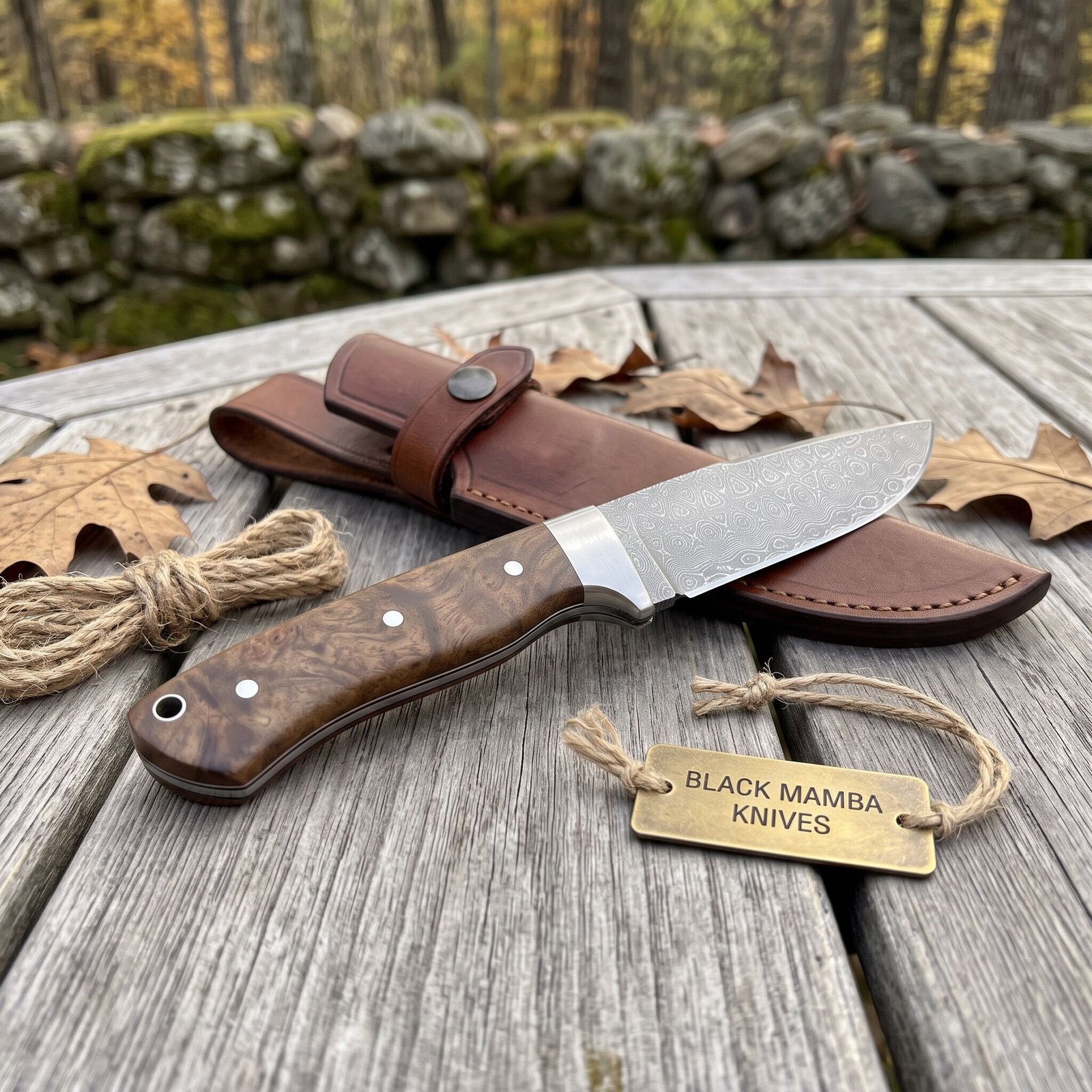
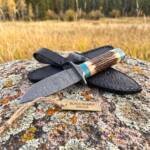
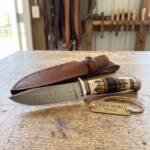
Two different steels in one knife, doing two different jobs. The blade is pattern-welded carbon; the bolster is 410 stainless. That is a deliberate choice and it changes how the Rhino behaves over years rather than weeks.
| Overall length | 9.8 inches |
| Blade length | 4.8 inches |
| Handle length | 5 inches |
| Knife type | Drop point fixed blade hunting knife |
| Steel | 1095 + 15N20 Damascus, 352 layers |
| Pattern | Layered Damascus pattern, forged and acid etched |
| Hardness | 58 to 60 HRC, oil tempered |
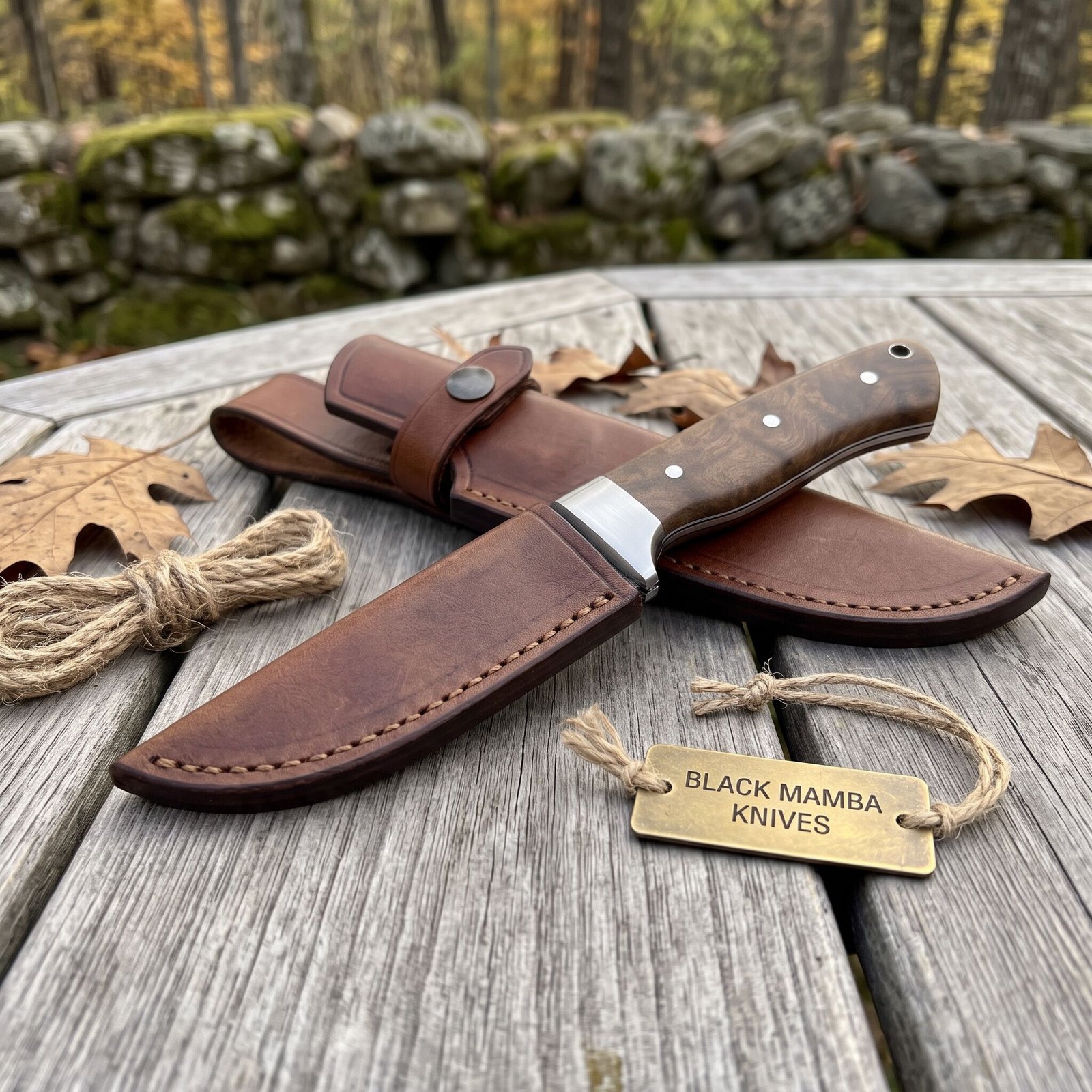
| Guard | 410 stainless steel bolster |
| Handle | Walnut burl wood scales with three pins and a lanyard hole |
| Weight | 10.2 oz |
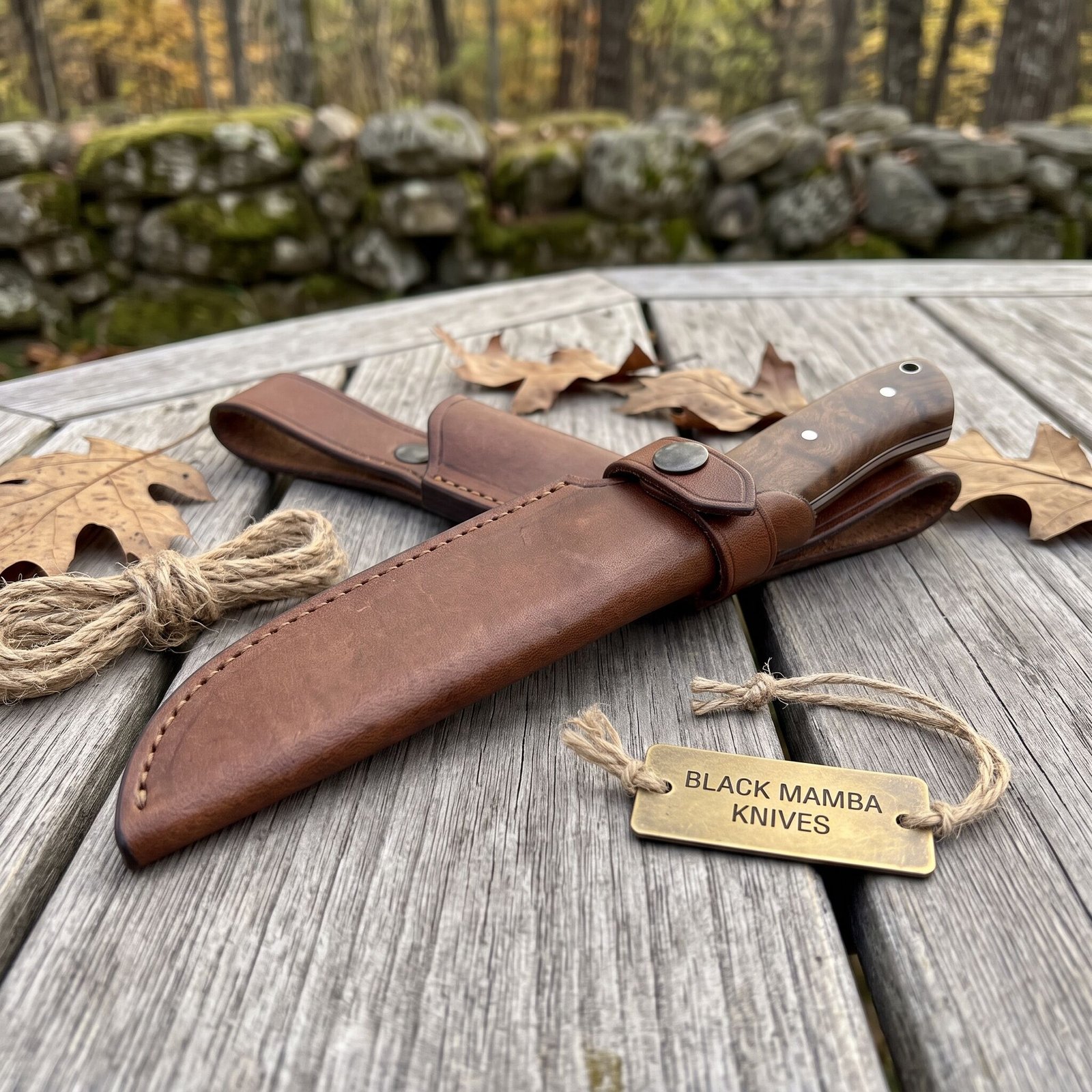
| Included | Hand stitched brown leather sheath |
The work it is meant for: big-game processing and heavy camp cutting. Just over ten ounces with the balance sitting forward at the bolster, so the knife falls into the cut. Not a knife for detail carving; a knife for getting through an animal.
Why a stainless bolster matters
The bolster is the collar of metal where the blade meets the handle, and on a working knife it is the wettest place on the whole thing. Water runs down the blade and stops there. Carbon steel in that position stains and eventually pits under the wood. Chromium-bearing 410 does not. The practical consequence is that this knife ages in two tones, the blade greys and mottles with use while the bolster stays bright, and the seam between wood and metal stays tight instead of weeping rust into the walnut. Some owners dislike the two-tone look. It is the price of a joint that holds up.
The edge, and keeping it
Folded carbon steel taken to this hardness takes a very keen edge and gives it back readily on a stone. It does not have the wear resistance of a modern powder steel, you will touch it up more often than you would a D2 blade, and it will reward you with a sharper edge each time you do. A few passes on a fine stone or a loaded strop after each session is the whole discipline. Do not take it to a dry grinding wheel, which draws the temper. If sharpening is unfamiliar, work through sharpening a knife on a whetstone before you start on a knife you care about.
Its upkeep: the two metals need different things. The blade wants drying and a film of oil; it will develop a grey patina and that is protection, not damage. The bolster needs nothing but a wipe. The walnut burl handle is the piece with a schedule: feed it a hardwax or wood oil roughly twice a year, more if you live somewhere dry, because burl figure moves more than straight grain when the moisture in it swings. Store it out of the sheath. Vegetable-tanned leather is mildly acidic and will mark a carbon blade left in it for a month.
Straight questions
Full tang? Yes, the tang runs the length of the handle.
How does it compare to a plain carbon knife? Better at resisting corrosion where it matters most, marginally more work to make. Damascus against D2, 440C and VG10 lays out the trade-offs.
Want more reach? The Yakushima twelve-inch bowie is the next size up in the same family of work.
Model: BMK-109
Emma L.: (verified owner) –
“I’ve always been drawn to the artistry of Damascus knives, and the one I recently acquired lives up to the craftsmanship I admire. Its sharpness and intricate patterns make it a kitchen tool I’m proud to own.”
Andrew C.: (verified owner) –
“As an amateur chef, I appreciate the beauty and functionality of the Damascus knife I added to my collection. Its sharpness is a cut above the rest, and its design adds a touch of elegance to my culinary creations.”
Lisa H.: (verified owner) –
“I’m a culinary enthusiast who values both aesthetics and performance in the kitchen. The Damascus knife I purchased is a true work of art that also happens to be incredibly sharp and precise. It elevates my cooking experience.”
Robert D.: (verified owner) –
“I’ve used various knives over the years, but the Damascus knife I recently acquired stands out for its exceptional quality. It’s a work of art that adds a touch of sophistication to my kitchen.”
Jennifer S.: (verified owner) –
“I’m not a professional chef, but the Damascus knife I own makes me feel like one. Its sharpness and precision are unmatched, and its beauty is a constant source of inspiration in my cooking.”
William R.: (verified owner) –
“I’ve been collecting knives for years, and the Damascus knife I recently added to my collection is a true gem. Its layers and patterns are mesmerizing, and it’s a testament to the artistry and skill of the craftsman.”
Amanda G.: (verified owner) –
“The Damascus knife I received as a gift has quickly become my most cherished possession in the kitchen. Its sharpness and the artistry of its blade patterns make every meal preparation a joy.”
Thomas C.: (verified owner) –
“I’m a professional photographer specializing in food photography, and the Damascus knife is one of my favorite subjects. Its patterns and sharpness add depth and character to my culinary compositions.”
Matthew Martinac (verified owner) –
Laura P.: (verified owner) –
“I purchased a Damascus knife for my daughter, who is an aspiring chef, and she couldn’t be happier with it. It’s not just a knife; it’s a piece of functional art that fuels her passion for cooking.”
Anonymous (verified owner) –