


Description
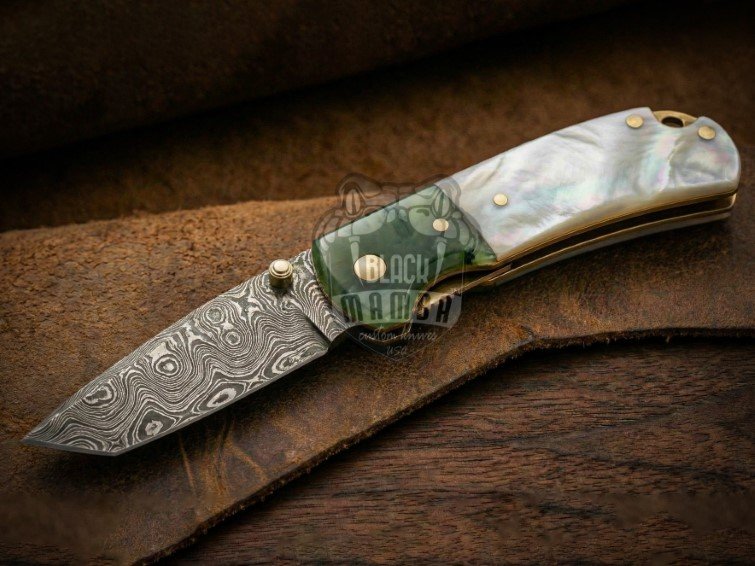
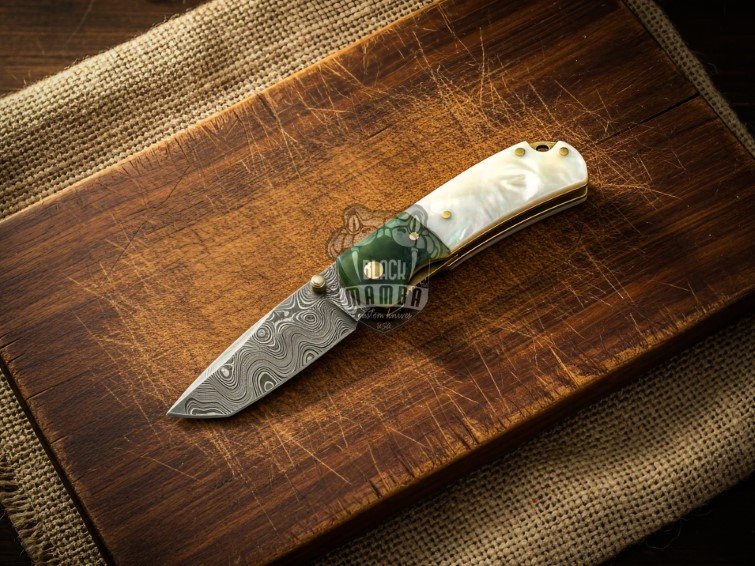
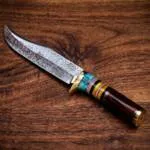
The green bolster is the first thing anyone notices. It sits between a raindrop-figured Damascus blade and two slabs of natural sea shell, and it changes tone as you turn the knife toward a window.
| Blade length | 3.5 inches |
| Handle length | 4 inches |
| Steel | 1095 + 15N20 Damascus |
| Hardness | 58–60 HRC, oil tempered |
| Handle | Sea Shell Color Bone Bolster |
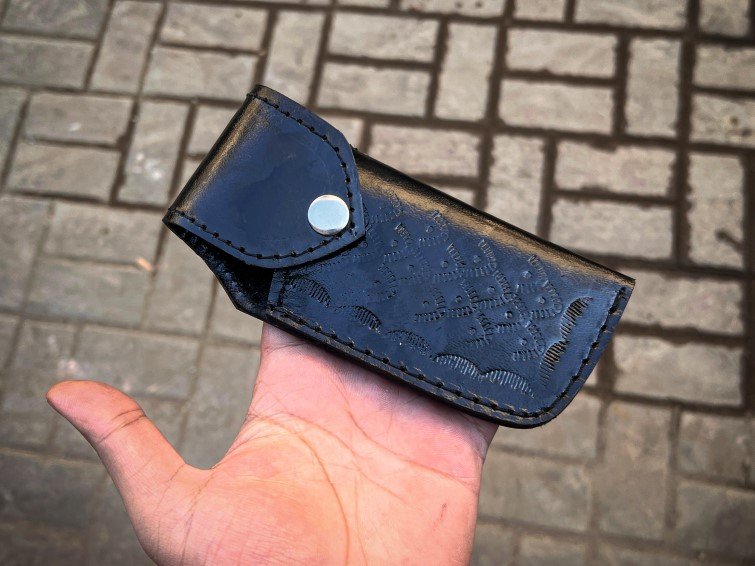
| Included | Hand-stitched leather sheath |
Who it suits: a buyer who wants a small folder that reads as jewelry until it opens. Three and a half inches of blade on a four inch handle closes into a shape that vanishes in a jacket pocket. Nobody buys this to break down cardboard. It is the knife you set on the table when somebody asks what you carry.
What the shell scales actually are
Sea shell is cut from a natural material, so no two sets are alike. On this one the slabs run cream through silver, with faint green and rose flaring across them under a direct light. Brass pins pass through to the liners. The bolster beside them is colored bone, dyed a deep green that answers the tones already moving in the shell. Shell is harder and more brittle than any wood scale. Treat it the way you would treat a watch crystal: it shrugs off scratches, but a fall onto concrete can chip a corner.
Why it comes with leather
A stitched leather sheath is unusual on a folding knife this size, and it is there for a reason. Pocket change and keys are what mar shell, not use. Slipping the closed knife into leather keeps grit off the scales and off the pivot. If you plan to carry this daily rather than display it, that pouch is the difference between scales that stay glossy and scales that go cloudy at the edges.
Sharpening a short Damascus blade
The grind is thin where it counts, just above the edge, and that is what makes a blade this short feel keen out of proportion to its size. Work it on a medium stone at a shallow angle and stop before you round the tip. The layered pattern is forged all the way through the billet, so grinding never wears it away.
Care. This blade is high-carbon Damascus, and high carbon spots when it stays damp. Dry it after every use and pass a rag with a trace of oil over the flats once a month. Keep the oil off the shell and off the bone; neither one absorbs it, and a film will only make them look dull. Wipe the scales with a dry cloth and nothing else. If lint packs into the pivot, blow it clear rather than rinsing it, because water that gets under a bolster settles against steel and stays there.
Questions buyers ask
Will the shell fade? No. Natural shell holds its color indefinitely. The leather is the part that will darken with handling.
Is a pattern like this printed on? It is not. The figure comes from folded and welded layers, which you can read more about in our guide to Damascus knife care and sharpening.
How do I clean it after a season in a pocket? Follow the steps in cleaning a folding pocket knife, but skip any soaking.
What if I want the same look in a stainless blade? The stainless VG10 folder in rosewood pairs the same materials with a steel that shrugs off humidity.
Model: BMK-677
Mary Bishop –
Showed up right on time and looked even better than the photos. Opens smooth every time with just a flick of the thumb. Highly recommend this one.
Richard Marsh –
This pocket knife looks even better in person than in the listing photos. Action smoothed out even more after a few days of carry. This one’s a keeper for sure. Proud to support American made goods out of Memphis with this purchase.
Scott Freeman –
This is one of those purchases that just makes you smile. Fits great in the pocket without feeling bulky. Lockup is rock solid with no wiggle in any direction. Blade centering is perfect right out of the box. This store just earned a repeat customer.
Christopher Edwards –
Got this as a Christmas present and it exceeded what I expected. Blade centering is perfect right out of the box. No hesitation recommending this to anyone looking.
Robert Gray –
Got this for my brother and now I want one for myself too. This has become my daily carry piece without question. Already planning my next pickup from this maker.
Susan Garcia –
This maker clearly knows what they’re doing with quality like this. This is my third order from Black Mamba Knives and they never disappoint.
Jonathan King –
My whole family passed this pocket knife around at dinner just to look at it. Blade centering is perfect right out of the box. Detent is snappy without being stiff to open. Opens smooth every time with just a flick of the thumb. Love that this comes out of Memphis and still ships worldwide this quickly. Great buy overall.
Xavier Lee –
Absolutely thoroughly impressed by this pocket knife. Fits great in the pocket without feeling bulky. Beyond happy with how this turned out.