
440C is the steel you buy when the knife is going to get wet, get ignored, and still be expected to cut. It is a high-carbon stainless with enough chromium to shrug off rust and enough carbon to take a genuinely sharp edge, which is a combination the rest of the steel world spent decades trying to beat and mostly failed to beat cheaply. Every 440C blade on this page is hand ground in our shop, heat treated in house, and finished by the same people who forge our Damascus.
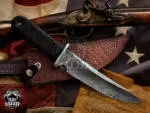
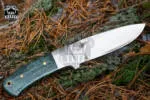
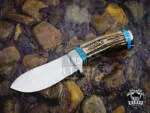
440C vs D2 vs 1095 vs Damascus
Four steels, four different jobs. Nobody needs all four, but knowing which one suits your week saves you buying a knife you never end up carrying.
| Steel | Hardness | Edge retention | Rust resistance | Toughness | Best for |
|---|---|---|---|---|---|
| 440C stainless | 58 to 60 HRC | Very good | Excellent | Good | Coast, boat, kitchen, fishing, daily carry |
| D2 tool steel | 58 to 62 HRC | Excellent | Good (semi-stainless) | Fair | Hunting and hard-use fixed blades |
| 1095 carbon | 57 to 59 HRC | Good | Poor, needs oil | Excellent | Choppers, bushcraft, tomahawks |
| 1095 and 15N20 Damascus | 58 to 60 HRC | Very good | Poor, needs oil | Very good | Pattern, gifts, collectors |
| 440C Damascus | 58 to 60 HRC | Very good | Very good | Good | Pattern without the maintenance |
Against our Damascus. Our 1095 and 15n20 Damascus takes a finer edge and carries the pattern, but it is reactive and wants drying and oiling. 440C forgives neglect. If the knife will live in a boat, a tackle box, a kitchen sink or a coastal climate, 440C is the honest recommendation.
Hardness. We run 440C at 58 to 60 HRC. Harder holds an edge longer but chips more readily; softer is tougher but dulls faster. This range is the working middle.
Finish. These take a high polish that shows every mark of the hand that ground them, which is why the mirror-finish pieces are the ones people buy as gifts.
Is 440C actually good knife steel?
Yes, with one caveat that is about marketing rather than metallurgy. When a cheap import says 440 stainless steel, it usually means 440A: the soft, inexpensive cousin that goes dull if you look at it sideways. 440C sits at the top of that family, roughly 1.0% carbon and 17% chromium, hardened to 58 to 60 HRC. So if a listing says only 440 stainless and the price looks too good to be true, it is almost certainly 440A. Ours is 440C, and we will tell you the hardness before you have to ask.
440C Damascus: the pattern without the babysitting
Damascus forged with stainless layers gives you the pattern people buy Damascus for, with corrosion resistance close to a plain stainless blade. The contrast is a little quieter than 1095 and 15N20 because stainless layers etch less dramatically, but you get a blade that survives a humid kitchen or a summer on the water without a film of surface rust as punishment. Want the loudest possible pattern? Buy carbon Damascus and keep an oiled rag handy. Want a knife you will actually use every day? This is the compromise worth making.
Sharpening and care
Any decent stone at about 20 degrees per side. The chromium carbides make 440C slightly more stubborn than carbon steel, so give it a few more passes and finish on a strop. Do not run it through a pull-through carbide sharpener unless you dislike the knife. Rinse and dry after contact with salt water, citrus or raw meat. That is the whole maintenance routine; there is no oiling ritual and no patina to manage.
Sheath, carry and what is in the box
Every fixed blade here ships with a hand-stitched leather sheath, cut and sewn for that specific blade rather than pulled off a rack of universal sizes. Belt loop, welt at the edge, and a fit snug enough that the knife stays put when you bend down. Folders ship with a pouch. Optional engraving is available on most pieces as a paid add-on if the knife is a gift.
440C questions we actually get asked
Is 440C actually rustproof? No steel is. It is highly rust resistant. Leave it wet in salt long enough and it will spot, but it tolerates far more than carbon steel.
Does it hold an edge as well as Damascus? Close. Damascus takes a keener edge; 440C keeps a good edge longer under abuse. Pick for how the knife will live.
How do I sharpen a 440C stainless steel knife? A medium stone at roughly 20 degrees per side, then a fine stone, then a leather strop. It takes a few more passes than carbon steel because of the chromium carbides, but no special equipment.
What is the difference between 440A, 440B and 440C? Carbon content. 440A has about 0.7%, 440B about 0.85%, 440C about 1.0%. More carbon means higher attainable hardness and better edge retention, which is why 440C is the only one of the three we use.
Is 440C better than D2? Neither is better; they trade. D2 holds an edge slightly longer and is easier to chip. 440C resists rust far better and is friendlier to sharpen. For a wet or coastal life, 440C. For a dry-climate hunting knife, D2.
What hardness do you run your 440C at? 58 to 60 HRC, heat treated in our own shop. That is the working middle: hard enough to hold an edge through a season, tough enough not to chip on bone.
Can 440C knives go in the dishwasher? They can survive it, but do not. Detergent and heat wreck the handle scales long before they trouble the blade. Hand wash, dry, done.
Is 440C good for a fishing or dive knife? It is one of the best choices in this price range. Rinse it in fresh water after salt exposure and it will outlast the tackle box it lives in.
Are these 440C knives made in the USA? Yes. Ground, heat treated, finished and sheathed in our own shop, not assembled from imported blanks.
More reading
Read our guides on telling real Damascus from a printed pattern, what 352 layers means and caring for a Damascus blade.
440C is also the steel we reach for on pocket knives and folders that live in a damp pocket all week, where a high hardness knife steel that resists corrosion matters more than a dramatic pattern.
The newest pieces on this page: C Hyena Knife, 440c PERSIAN YUMA Knife, Black Scorpion 440C Knife and 440c PERSIAN YUMA BLACK Knife.
