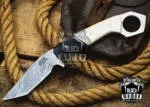
The karambit came out of the rice fields of the Indonesian archipelago as an agricultural tool, and the curved blade and finger ring are both leftovers from that work rather than styling. The ring meant the blade could not be dropped with wet hands; the curve followed the sweep of a cutting stroke. It is now carried mostly as an EDC and collector piece, and it remains one of the most secure knife shapes to hold.Grip. The index finger goes through the ring. Held that way the knife cannot be pulled out of the hand, which is the whole point of the design and why it is also awkward for ordinary kitchen or camp tasks.Ours. Hand-forged 1095 and 15n20 Damascus at 58 to 60 HRC, full tang through the ring, with buffalo horn, rose wood or micarta scales and a fitted leather sheath.Is a karambit legal to carry? Please check your local law before ordering.Fixed or folding? Fixed blades are stronger and simpler; there is no pivot to loosen. Folding karambits are easier to pocket. We forge both.How do I sharpen a curved blade? Work in short sections along the curve, keeping the same angle, rather than trying to drag the whole edge across the stone in one pass. A rod or a small round stone is easier than a flat bench stone.n
What Makes a Karambit a Karambit
n
The karambit is Southeast Asia’s answer to the tiger claw — a curved blade, a safety ring for the index finger, and an edge on the inside of the curve. It started life as a Filipino and Indonesian farm tool for cutting rice stalks and rope, which is worth remembering next time a movie tells you otherwise. The curve does real work: it hooks, it pulls a cut through material, and the ring means the knife stays in your hand when your grip is wet.
n
Karambit vs Straight Blade
n
| Damascus Karambit | Straight Fixed Blade | |
|---|---|---|
| Edge | Inside the curve — pulls cuts through | Straight or bellied — pushes and slices |
| Grip security | Finger ring — nearly impossible to drop | Handle shape and texture only |
| Best at | Utility hook cuts, rope, collection display | General camp, hunting, food work |
| Learning curve | Real — the curve rewards practice | None to speak of |
n
Forged in Memphis, USA
n
Each damascus steel karambit is hand-forged from 1095 and 15N20 high-carbon steel — 352 layers, 58–60 HRC — with the pattern running through the blade, not printed on it. Grinding a symmetrical edge on the inside of a curve is some of the fussiest work in the shop, which is exactly why collectors love the result. Pair it with a Damascus bowie or browse our Damascus daggers.
n
FAQs
n
What is a karambit knife used for? Originally agriculture — rice, rope, roots. Today: utility cutting where a hooked edge shines, martial-arts training with trainers, and collecting. Ours are working blades with collector-grade Damascus.
n
Are karambit knives legal in the US? Federally yes; a fixed-blade karambit is treated like any fixed blade in most states, but a few states and cities restrict carry — always check your current local law before ordering or carrying.
n
Is a Damascus karambit strong enough to use? Yes — 1095/15N20 at 58–60 HRC is the same steel our hunting knives run. The pattern is not a coating; it is the blade.
n
How do you sharpen a curved karambit blade? With a round or oval rod worked along the inside curve — a flat stone only touches the very edge of the arc. Slow passes, consistent angle. See our sharpening guide for fundamentals.
n
Does it come with a sheath? Yes — every karambit ships with a fitted leather sheath.